Friday, May 12, 2017

Remembered Death and A Caribbean Mystery

Books 51 and 52 are both by Agatha Christie and since I finished one yesterday and the other today, I decided to do one post.

Remembered Death/Sparkling Cyanide:

At Rosemary Barton's birthday, her guests saw her drink champagne and then collapse. The verdict was suicide, she has been depressed following a bout of the flu. Six months later, her husband George received an anonymous letter that said his wife had been murdered. Questions were asked and the invitees began to remember things. But someone remembered one thing too many and the murderer struck again.


  • George Barton: Rosemary's devoted husband
  • Iris: Rosemary's younger sister. Penniless while Rosemary was alive, she inherited Rosemary's fortune.
  • Stephen Farraday: a rising member of Parliament. He had an affair with Rosemary. Public knowledge of the affair would be disastrous for his career.
  • Lady Alexandra Farraday: Stephen's wife. She may or may not have been aware of his affair with Rosemary.
  • Anthony Browne: A shifty American who deals in armaments. He also had an affair with Rosemary.
  • Ruth Lessing: George Barton's secretary. She loves her boss and without Rosemary in the picture, she could make a fine wife for him.
  • Lucilla Drake: a distant relative of Rosemary and Iris. She looked after the girls following their parents' deaths. Believes everything her son, Victor says. 
  • Victor Drake: a good-for-nothing scoundrel who frequently wires his mother for money.


A Caribbean Mystery:

Miss Marple is enjoying a holiday in the Caribbean courtesy of her nephew and his wife. While, there, Miss Marple listens to Major Palgrave's endless stories about his travels and former exploits. Major Palgrave claims to know of a  murderer, and what's more, he has a photograph of this person (the photograph was given to him by a friend). That night Major Palgrave dies. At first, his death is attributed to high blood pressure and too much alcohol. But Miss Marple has her doubts and further investigations prove that he was murdered. Several people had heard Major Palgrave tell this story about a murderer, and no one is safe until the murderer is caught.
I don't like the cover of my English version, but I do like the cover my French version (The Major Talked Too Much).

Sunday, May 7, 2017

Book 50: Closed Casket

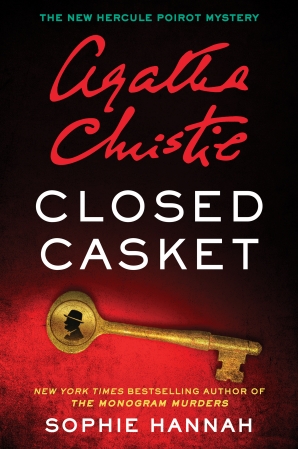
Closed Casket : The New Hercule Poirot Mystery by Sophie Hannah

As I've mentioned before, Agatha Christie is my favorite author and Poirot is my favorite detective of hers. I was hesitant to read Hannah's newest Poirot adventure and was convinced I wouldn't like it. I did enjoy the story (I read the entire thing in one day), but not as a Hercule mystery. While there were elements common to Christie's novels, I felt they were underdeveloped and/or completely random.

Lady Athelinda Playford is a famous novelist of the Shrimp Seddon mysteries for children. (This was reminiscent of Ariadne Oliver). Lady Playford invites Inspector Edward Catchpool of Scotland Yard and Hercule Poirot to stay at her country estate, Lillieoak, County Cork Ireland. Prior to their arrival, Lady Playford meets with Micheal Gathercole, her solicitor, and asks him to rewrite her will. Lady Playford's new will leaves everything to her secretary, Mr. Joseph Scotcher who is terminally ill with Bright's disease. Left out of her will are her two children, Viscount Harry and his wife Viscountess Dorothy, and her daughter Claudia and her fiancee Dr. Randall Kimpton.

Lady Playford announces her revised will during dinner. As expected, the information isn't received well. Her children are shocked, as is Joseph Scotcher. That night someone is murdered. The incompetent Irish Inspector begrudgingly agrees to let Poirot and Catchpool assist with the investigation. Poirot uses his little grey cells, takes a trip to England to gather information, and finally gathers everyone together to unmask the murderer.

One of the things I love about Poirot is his sense of self-importance and his lack of modesty. In Closed Casket, I found Poirot rather subdued. I honestly think Poirot could have been replaced with a differently named private investigator and the story would have been fine.


Wednesday, May 3, 2017

A Paris Apartment

Book 49: A Paris Apartment by Michelle Gable

April Vogt, a Continental Furniture Specialist at Sothebys, is sent to Paris to inventory the contents of a Parisian apartment that has been sealed for 70 years, since 1939.

The apartment once belonged to Marthe de Florian, a demimondaine of the Belle Epoque. Marthe's treasures are numerous, but the most shocking of all is a previously unknown portrait by the artist Boldini. April also discovers Marthe's journals which provide provenance for the items in the apartment, but also help her discover who Marthe was. Or who she appeared to be.

Marthe's journals help April discover things about herself. April has left a cheating husband in New York , (whether temporarily or permanently she has yet to decide), a family crisis that has been brewing for decades, and her less-than satisfying career in New York. As her personal life reaches a tipping point, April is tempted by wine, pastries, and the handsome solicitor who works on behalf of Marthe's heir.

Will the auction give Marthe the glory she so desperately sought and allow April to find her happy ending?

I found both Marthe's and April's stories compelling. April uses the journals as a way to escape her present-day problems and the two narratives are interspersed.


This novel is based on true events. See here for a look at Marthe de Florian's apartment:

http://shareably.net/art-found-in-paris-apartment-that-
was-vacant-since-1939/

Marthe's portrait by Giovanni Boldini

Friday, April 28, 2017

The 6:41 to Paris

Book 48: The 6:41 to Paris (original French title 06h41) by Jean-Philippe Blondel

Cecile, a stylish 47-year old, has spent the weekend visiting her parents in Troyes, a small town about an hour  and a half from Paris. Exhausted by her visit, she takes the 6:41 express train back to Paris on Monday morning. The seat next to her is empty, but before long is occupied by a man from her past. The man is Philippe Leduc, with whom she had a brief, though passionate relationship 30 years ago that left her humiliated.

The narrative is a journey through their respective thoughts and reflections. Each one recognizes the other, but doesn't want to break the silence. They reflect on their past and present lives.

This reminded me of another French novel structured in much the same way. Michel Butor's La Modification, written in 1957. La Modification follows L.D. on a train trip from Paris to Rome. While riding the train, L.D. makes many mental stops and transfers as he reflects on his past romantic relationships.

While reading, I wondered what I would say to a friend or former boyfriend whom I hadn't seen for 30 years if I happened to sit next to him/her on a train or plane. In the 6:41 to Paris, the past is lying is lurking, waiting to ambush Cecile and Philippe.


Wednesday, April 26, 2017

Get Well Soon

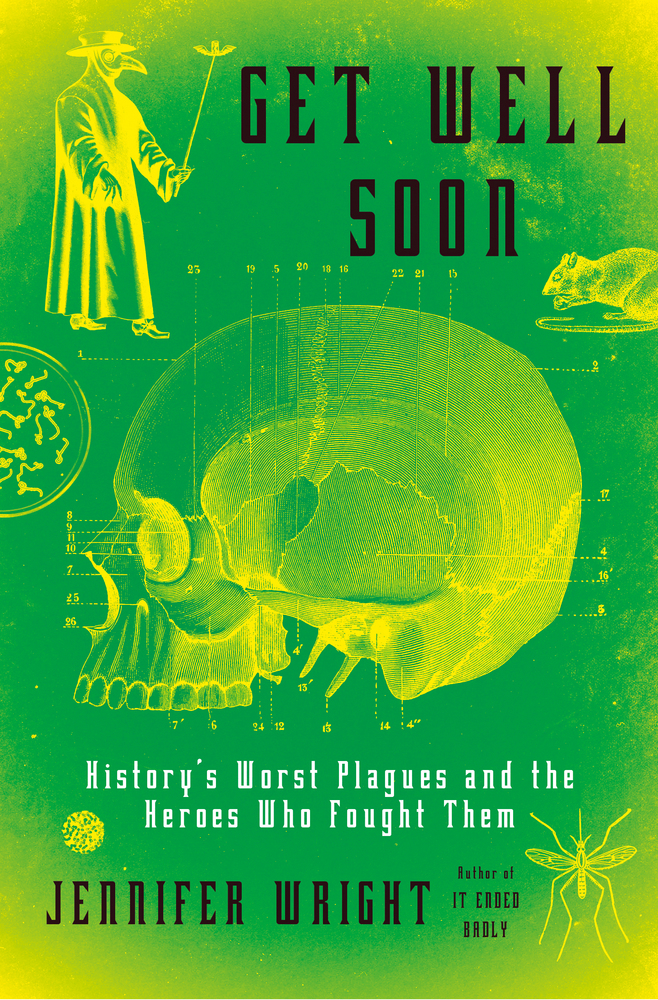
Book 47: Get Well Soon: History's Worst Plagues and the Heroes Who Fought Them by Jennifer Wright

I finished this a few days ago, but moving interrupted my blogging about it. The hypochondriac in me enjoys reading about diseases, and Wright's book about plagues was no exception. Although I have no interest in a career in the sciences or in medicine (I would be a terrible nurse or doctor), I do find these topics interesting.

The plagues include:
The Antonine Plague
Bubonic Plague
Dancing Plague
Smallpox
Syphilis
Tuberculosis
Cholera
Leprosy
Typhoid
Spanish Flu
Encephalitis Lethargica
Lobotomies
Polio

Wright situates each plagues in the historical moment or moments of its outbreak. Known or suspected  causes are discussed as well as attempts and successful remedies or cures. Some of the remedies are horrific and others are laughable. For example, to ward off or cure the bubonic plague, it was suggested that people: drink a small amount of good wine, eat crushed emeralds, eat eggs, fruit, and vegetables, not look at sick people, chopping up raw onions and placing them around the house, and drinking your urine/buboes pus. There was also a cure involving exploding frogs and exploding pigeons.

A large part of each chapter is about the attitudes toward a specific plague and how they affect treatment of patients and how we discuss the disease itself. For example, in order to keep morale high during WWI, news of the Spanish Flu outbreak was deliberately censored from the press. This meant that is estimated to have killed 25-100 million people worldwide. Had the outbreak not been kept out of the press for so long, fewer people might have died. In the case of leprosy, there isn't a cure, but treating lepers with compassion and as actual human beings, had a profound effect on their outlook on life. In the case of Polio, a vaccine was ultimately developed because money, resources, and attention were given to combating it.

Although details are sometimes gruesome, Wright's approach is light-hearted and irreverent.


Friday, April 7, 2017

To Capture What We Cannot Keep

To Capture What We Cannot Keep by Beatrice Colin

In 1886, Caitriona Wallace and Emile Nouguier meet in a hot air balloon above Paris. They feel an affinity for one another, but when the balloon lands, their different social positions become apparent. Caitriona (Cait) is a widow who has agreed to chaperone two wealthy, spoiled, and out-of-touch-with-reality Scottish charges, Jamie and Alice Arrol. Emile is one of the engineers building the Eiffel Tower. His mother expects him to take over the family business and find a suitable wife in order to maintain his bourgeois respectability and stability.  As the tower is constructed, Cait and Emile must decide how important their love for each other is.

This first passage is from the hot air balloon ascent. "And there, far below, were Baron Haussmann's wide boulevard's that followed the line of the old walls of the city, the green blot of the Bois de Boulgone, the pump of black smoke from the factories in the south, the start spokes radiating from the Place de l'Etoile, and, closer, the Place du Trocadero. And there were lines of carriages as tiny as black beetles, people as minute as ants, the city as small and regular as a set of children's stone building blocks placed on a painted sheet" (17-18).

I loved this description because now the Eiffel Tower is such an iconic part of the Parisian landscape. It's hard to imagine Paris without La Dame de Fer. Though the Eiffel Tower provides one of the best panoramas of Paris, the one thing you cannot see from atop the tower is the tower itself. My favorite vantage point to look out over Paris is from the top of Sacre Coeur or from the top of the Arc de Triomphe.

I also likes this passage about leaving a beloved city, especially Paris. "The morning they had left Paris the sky had been a fathomless blue, the air so clear and clement that everything they were about to leave behind -- the streets, the people, the smell of roasted coffee and chestnuts -- seemed sharper, the colors deeper and more saturated, the verticals and perpendiculars of the city engraved rather than drawn" (108). I find leaving Paris bittersweet, but in order to return, one must leave.


Thursday, April 6, 2017

#45 Death Comes to the Village

Death Comes to the Village by Catherine Lloyd is the first book in the Kurland St Mary mysteries.

If I have learned anything from reading Agatha Christie's Miss Marple and watching/reading the Midsommer Murders, it's that life in an English village is anything but tranquil.

In 1816, Major Robert Kurland has returned to his family home in the village of Kurland St Mary following an injury at the Battle of Waterloo (his legs were crushed by a horse). One night he notices a strange figure struggling with a heavy load in the Churchyard. Shortly thereafter, several petty thefts are notices in the houses of the gentry, and two local girls go missing. Major Kurland enlists the help of his childhood friend and the rector's daughter, Lucy Harrington to investigate. As the rector's daughter, Lucy is admitted to houses throughout the village, belonging to people from all social strata.

I enjoyed the banter between Lucy and Major Kurland. I suspected three people of committing the crimes, but none of them turned out to be the culprit. I look forward to reading the second book in the series, Death Comes to London.