Tuesday, May 1, 2018

100 Places That Can Change Your Child's Life

100 Places That Can Change Your Child's Life: From Your Backyard to the Ends of the Earth by Keith Bellows, writer and editor of "National Geographic Traveler Magazine"

The premise of this book is simple, give your children the gift of travel. Teach them how to travel in order for them to travel to learn. The world is the greatest classroom for children. Sadly, a 2006 National Geographic poll found that American children are not very culturally literate. Only 37% could find Iraq on a map, 20% thought Sudan was in Asia, and half couldn't identify New York on a map (7). I am guilty of a lack of geographic knowledge; my world geography and even U.S. geography is terrible. Although I do try to read about other places and travel when I can.

As a parent, I want to travel with my children and take across the country and even around the world. As a National Geographic publication, this book doesn't fail to deliver and is highly informative. The book is divided into regions: United States/Canada, Caribbean/Mexico/South America, Europe, Africa/Middle East, Asia, and Oceania/Antarctica. Each entry includes a page or two about the chosen place with historical highlights and itinerary suggestions from locals or local guides. I particularly liked the recommended reading/media section at the bottom of each page. There were two or three books, CDs, or movies for each place either for children or for children and adults. I also found it interesting that there were no pictures in this book, rather unusual for a travel book.

I did find a few limitations with the scope of this book. Although the title mentions "your backyard" none of the places mentioned quite fit this bill. All of them are large cities, famous landmarks, or well-known places. For example, Mount Rushmore, Manhattan, Gettysburg, Paris, London, Vatican City, Pyramids of Giza, Jerusalem, the Serengeti, Taj Mahal, The Great Wall of China, and the Great Barrier Reef. Some of these places may indeed be local, but I also feel many of them are cost prohibitive. I think the book could have been improved by making cheaper suggestions; instead of bird-watching in the Serengeti, go to your local State Park and bird-watch or identify fish in a local lake.

Image result for 100 places that can change your child's life

Image result for 100 places that can change your child's life

Thursday, April 5, 2018

Book 100

I've finished my 100th book today! That means I have completed 10% of my goal to read 1,000 books. I started this project in July of 2016, so about a year and a half ago.

Book 100 was Theft by Finding: Diaries 1977-2002 by David Sedaris. My first exposure to Sedaris was listening to the audio version of When You Are Engulfed in Flames. Like many people, I thought I was listening to a woman [read his stories], but I later realized that this unique voice was David's. Theft by Finding is not all of his diary entries for 30-odd years, but at 514 pages the entries are significant. Incidentally, this blog is the most successful "diary" I've ever kept.

My favorite entries are about his adventures learning French and the time he spends in Paris and Normandy.

There's this gem about waiting for a taxi in Paris. You are supposed to wait in line and disabled people are given priority. "This seems fair, seeing as the buses and subways are inaccessible, but then it got out of hand, and a dozen more people headed to the front. Either the train from Lourdes had just pulled up or owning a cell phone and a little to much gold jewelry are now considered handicaps by the French government" (359).

Sedaris is the type of French student teachers dream of. First, he types his homework and he fastened the pages together with a paperclip (a staple would be better, but still). "She told us to keep our sentences simple, and I didn't quite obey. But why write 'I went to the store with a friend' when, without relying on the dictionary, I can say, 'I visited the slaughterhouse with my godfather and a small monkey'? " (361). In high school English, I made my vocabulary sentences have a them, but nothing quite like Sedaris' creativity.


Here is a link for my favorite David Sedaris clip.

Saturday, March 31, 2018

Lady Killers

My last book for March and book 99 on my book list is Lady Killers: Deadly Women Throughout History by Tori Tefler.

Tefler writes about female serial killers throughout history including: Erzebet Bathory: The Blood Countess Lizzie Halliday: The Worst Woman On Earth, Tillie Klimek: High Priestess of the Bluebeard Clique, Raya and Sakina: Vipers and more.

Tefler avoids the sensationalism that is often associated with serial killers, but especially with female serial killers. Serial killers are anomalies and female ones even more so. In order to explain their monstrosity, perversion, inhuman, and un-womanly behavior, female serial killers' crimes are often attributed to over-sexualization, abuse, mental deficiencies, or hysteria. Tefler presents these women as women and human, however flawed they may have been. Tefler avoids exoticising and objectifying these female serial killers and instead tries to understand the motivations behind their crimes.


Thursday, March 29, 2018

The Butterfly Mosque

The Butterfly Mosque by G. Willow Wilson

Willow was raised as an atheist in Colorado, but was attracted to Islam and Arabic in college. Post 9/11, Willow went to Cairo, Egypt for a semester to teach English. She stayed and immersed herself fully in Cairene culture. Willow fell in love with Omar and the two began a relationship and later married. The Butterfly Mosque is Willow's memoir of her physical and spiritual journey in Cairo. I was particularly struck by her conversion to Islam; a choice she made before meeting Omar and one that was expressed personally and internally more so than externally.

Here are a few quotes I liked:

Prior to announcing their intended married to her mother-in-law: "I don't like just showing up like this. 'Hi, I'm your white American in-the-closet-convert future daughter-in-law. I've brought you some flowers and a catastrophe.'" (50)

On her conversion: "Looking back, the way I chose to "come out" taught me something vital: anything undertaken with honest intentions can be justly defended. I never by word or action claimed to possess a higher or a universal truth, only a very personal one; i think this was one of the main reasons I was able to slip quietly into "ordinary" Islam, without the fanfare that accompanies conversion. I never tried to become a mascot; I was just a person, with the usual quirks and faults, who was now Muslim" (107).

On engaging with native and other cultures: "The reason I had stayed in Egypt and invested myself in it so thoroughly was simple: this was the place I found myself in and the people I found myself among, and I wanted to do right by them. I had gone to Egypt to see what Islam was like as a practice and to find out whether the Arab world resembled the one portrayed in the media; I had stayed not to see, but to participate. I had discovered that both Islam and the Arab world were far from ideal--that the religion I loved was becoming steadily warped and was the source of many excuses for violence and ignorance and misanthropy. Yet I was not disappointed. This was what was so impossible to explain to the satisfaction of the people back home: I was not disappointed"  (230).


Monday, March 26, 2018

The Woman in the Photograph

The Woman in the Photograph by Dana Gynther

In 1929, Lee Miller heads to France. After seeing a photograph that Man Ray took of Kiki de Montparnasse, Lee decides that she MUST work for Man Ray and study his technique. Lee tracks him down and the two quickly begin a personal and professional relationship. Man declares that Lee is his muse, but as she works for him and alongside him, Lee's talents as a photographer develop. Lee seeks out her own jobs as a photographer, for Vogue, at the Sorbonne, and even stars in a Surrealist movie. Lee's independence angers the possessive Man Ray and drives a wedge between them. Lee is no longer content to simply be a muse, her artistic vision is paramount to her.

As far as the identity of the woman in the photograph, I think there are a few possibilities. I'm not referring to a specific photograph mentioned in the novel; in fact any of them will work. The woman could refer to Kiki, whose photograph by Man Ray first caught Lee's interest in his work. The woman could be Lee herself in the portraits of her taken by Man Ray. Or, the woman is the anonymous woman or muse captured on film, often cropped, edited, or "photoshopped" to bits and no longer recognizable as any specific woman, but merely an assemblage of body parts.

Based on actual events and people, I enjoyed learning about two photographers I knew nothing about.


Thursday, March 22, 2018

The Radium Girls

The Radium Girls: The Dark Story of America's Shining Women by Kate Moon

Lip...dip...paint...

Following the Curies' discovery of radium in 1898,  radium was everywhere in the early 1900s. Radium's harmful effects were hidden from the public and radium powder was put in tonic water, body lotion, everything.

Radium's glowing property made it essential to the war effort. Women were hired to paint watch dials with radium powder that would glow in the dark. The United States' entry into WWI in 1917 skyrocketed the need for women dial painters.

The Radium Girls tells the story of dial painters in New Jersey at the Radium Luminous Materials Corporation, later the United States Radium Corporation, and in Ottawa, Illinois at the Radium Dial Company.

So harmless was radium powder declared to be that the dial painters fairly bathed in it. They sometimes used extra powder like makeup, and the powder inevitably settled into their clothes and hair. "When I went home and washed my hands in a dark bathroom, they would appear luminous and ghostly. My clothes, hanging in a dark closet, gave off a phosphorescent glare. When I walked along the street, I was aglow from the radium powder" (44). The dial painters were laughingly called "ghost girls".

Unfortunately, the harmful radium powder entered their bodies. The technique of lip...dip...paint meant that the girls ingested small quantities of radium each day. The radium powder settled in their bodies and remained their for years, haunting them.


As we know today, and indeed scientists knew it then, exposure to radium is harmful. The "ghost girls" became the walking dead. Many dial painters became ill and died from their work...losing teeth, jawbones, developing cancers or sarcomas...

Many of the women believed that their employers were responsible for their ill-health. Together they filed several lawsuits. The mistreatment of the dial workers ultimately led to the creation of OSHA.

"United they triumphed. Through their friendship, through their refusal to give up and through their sheer spirit, the radium girls left us all an extraordinary legacy. They did not die in vain. They made every second count" (396).


Newspaper coverage of Catherine Donahue's trial


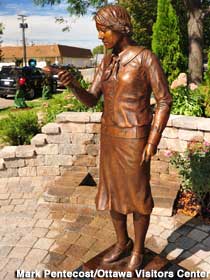
Memorial Statue in Ottawa, Illinois


Thursday, March 15, 2018

Winter Solstice

#95
Winter Solstice by Rosamunde Pilcher

This pleasant story about the families we have and those that we make, takes place around Christmas.
Elfrida, aged 62, is a retired actress. After her lover dies, she moves from London to a small English village (the type of village featured on "Escape to the Country") and befriends the Blundells--Oscar, Gloria, and their daughter Francesca. Following a tragedy, Elfrida and Oscar move to Scotland, to Oscar's family home. Oscar and Elfrida seem to attract other strays, people down and out on their luck or simply at a crossroads in life.

I enjoyed this cosy story and the patchwork of friends and family Pilcher created. This was the first novel by Pilcher that I have read and I think I'll read some more.