The Five Love Languages of Children by Gary Chapman, PhD and Ross Campbell, M.D.
You may be familiar with Chapman and Campbell's workshops or other book about the five love languages in marriage. I had heard about them, but didn't know what these 5 love languages were. In this book, Chapman and Campbell explain how to identify your child's primary love language, how to speak your child's primary love language, and the emotional, social, and behavioral benefits of doing so for you and your child. Every child needs to hear the words, "I love you." But, beyond saying "I love you", love is translated and expressed in one or more love languages. The five languages are: physical touch, words of affirmation, quality time, gifts, and acts of service. All children speak all of the love languages, but they tend to favor or respond best to one of them. For example, I suspect my daughter's primary love language is physical touch, but quality time is a close second. Speaking your child's love language fills his or her emotional tank, leading to a happy, responsive child.
I found this book helpful for communicating with my child and the chapters about discipline and using the love languages to discipline in a positive manner were informative.
Wednesday, November 28, 2018
Monday, November 26, 2018
The Other Einstein
In 1896, Mileva (Mitza) Maric arrives in Zurich to attend the Polytechnic Institute. Female students are uncommon at the University, female students of physics are even more unusual. As she entered the classroom for the first time, she heard her father's words echoing in her head, the familiar Serbian tongue a comfort, "You are a mudra glava. A wise one. In your heart beats the blood of bandits, our brigand Slavic ancestors who used any means to get their due. Go get your due" (Benedict 3-4).
The Other Einstein is the story of Mileva Marić, Albert Einstein's first wife. Mileva was a brilliant physics scholar in her own right. Her role in Albert's theories is a debate in the physics community. Marie Benedict writes, "the question of what role she truly played in Albert's 'miracle year' of 1905 became an examination of how Mileva was forced to subsume her academic ambitions and intellect to Albert's ascent and how she had to disguise her own discoveries as his. Her story was, in many was, the story of many intelligent, educated women whose own aspirations and contributions were marginalized in favor of their spouses." (Introduction). Unfortunately, this gender inequality still transpires in academia. It is only by seeking, defending, and fighting for one's due that such inequalities can become a thing of the past.
The events of the book take place between 1896 and the Einstein's divorce in 1914. Mileva narrates the entire story. Early chapters present a vivid portrait of a lively young woman arriving at university and struggling to find her footing in the male-dominated world of physics. Upon meeting fellow student Albert, Mileva felt lost, "Lost as in directions. Lost to myself. Lost to him." As their research and romance progress, Mileva becomes a shadow of herself. Einstein pushes her aside and relegates her to traditional woman's roles of child-rearing and housekeeping. The Other Einstein becomes a bleak portrait of life in the shadow of a genius. One example of Einstein's dominance is his erasure of Mileva's name on their published theory; his reasoning is that they are one--one stone, Ein stein. As one can guess, Mileva did not get her due, at least not from Albert.
Go get your due!
The Other Einstein is the story of Mileva Marić, Albert Einstein's first wife. Mileva was a brilliant physics scholar in her own right. Her role in Albert's theories is a debate in the physics community. Marie Benedict writes, "the question of what role she truly played in Albert's 'miracle year' of 1905 became an examination of how Mileva was forced to subsume her academic ambitions and intellect to Albert's ascent and how she had to disguise her own discoveries as his. Her story was, in many was, the story of many intelligent, educated women whose own aspirations and contributions were marginalized in favor of their spouses." (Introduction). Unfortunately, this gender inequality still transpires in academia. It is only by seeking, defending, and fighting for one's due that such inequalities can become a thing of the past.
The events of the book take place between 1896 and the Einstein's divorce in 1914. Mileva narrates the entire story. Early chapters present a vivid portrait of a lively young woman arriving at university and struggling to find her footing in the male-dominated world of physics. Upon meeting fellow student Albert, Mileva felt lost, "Lost as in directions. Lost to myself. Lost to him." As their research and romance progress, Mileva becomes a shadow of herself. Einstein pushes her aside and relegates her to traditional woman's roles of child-rearing and housekeeping. The Other Einstein becomes a bleak portrait of life in the shadow of a genius. One example of Einstein's dominance is his erasure of Mileva's name on their published theory; his reasoning is that they are one--one stone, Ein stein. As one can guess, Mileva did not get her due, at least not from Albert.
Go get your due!
Monday, November 12, 2018
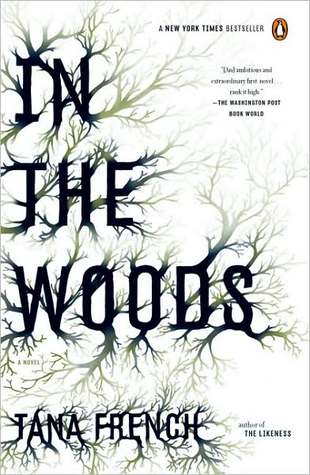
In The Woods
In The Woods by Tana French is a psychological thriller published in 2007. It is the first in the Dublin Murder Squad series. French's writing is different from what I usually read and it took me a while to become accustomed to her style, but I loved this novel.
Three children, Germaine (Jaime) Rowan, Adam Robert Ryan, and Peter Savage go missing on the afternoon of August 14, 1984 in the woods of Knocknaree (outside of Dublin). When the police are called, they are only able to find one of the children--with his shirt torn, shoes bloody, and no recollection of what happened to him or to his friends in the woods. Twenty year"s later, Detective Rob Ryan (the boy who was rescued) and his partner Cassie Maddox investigate the murder of a twelve year old girl in the same woods. This investigation is Ryan's best chance of solving the mystery of his own past.
The wood of Knocknaree is a character in its own right, living, breathing, and driving much of the novel. "The wood is all flicker and murmur and illusion. Its silence is a pointillist conspiracy of a million tine noises--rustles, flurries, nameless truncated shrieks; its emptiness teems with secret life, scurrying just beyond the corner of your eye....These three children own the summer. They know the wood as surely as they know the microlandscapes of their own grazed knees; put them down blindfolded in any dell or clearing an t they could find their way out without putting a food wrong. This is their territory, and they rule it wild and lordly as young animals; they scramble through its trees and hide-and-seek in its hollows all the endless day long, and all night in their dreams....These children will not be coming of age, this or any other summer. This August will not ask them to find hidden reserves of strength and courage as they confront the complexity of the adult world and come away sadder and wiser and bonded for life. This summer has other requirements for them" (French 2).
French writes a complex and multi-layered tale. At the end, what happened in the woods is clearer, but the truth remains elusive. Our narrator, Detective Ryan, cautions readers of this. "What I warn you to remember is that I am a detective. Our relationship with truth is fundamental but cracked, refracting confusingly like fragmented glass. It is the core of our careers, the endgame of every move we make, and we pursue it with strategies painstakingly constructed of lies and concealment and every variation on deception" (French 3).
Three children, Germaine (Jaime) Rowan, Adam Robert Ryan, and Peter Savage go missing on the afternoon of August 14, 1984 in the woods of Knocknaree (outside of Dublin). When the police are called, they are only able to find one of the children--with his shirt torn, shoes bloody, and no recollection of what happened to him or to his friends in the woods. Twenty year"s later, Detective Rob Ryan (the boy who was rescued) and his partner Cassie Maddox investigate the murder of a twelve year old girl in the same woods. This investigation is Ryan's best chance of solving the mystery of his own past.
The wood of Knocknaree is a character in its own right, living, breathing, and driving much of the novel. "The wood is all flicker and murmur and illusion. Its silence is a pointillist conspiracy of a million tine noises--rustles, flurries, nameless truncated shrieks; its emptiness teems with secret life, scurrying just beyond the corner of your eye....These three children own the summer. They know the wood as surely as they know the microlandscapes of their own grazed knees; put them down blindfolded in any dell or clearing an t they could find their way out without putting a food wrong. This is their territory, and they rule it wild and lordly as young animals; they scramble through its trees and hide-and-seek in its hollows all the endless day long, and all night in their dreams....These children will not be coming of age, this or any other summer. This August will not ask them to find hidden reserves of strength and courage as they confront the complexity of the adult world and come away sadder and wiser and bonded for life. This summer has other requirements for them" (French 2).
French writes a complex and multi-layered tale. At the end, what happened in the woods is clearer, but the truth remains elusive. Our narrator, Detective Ryan, cautions readers of this. "What I warn you to remember is that I am a detective. Our relationship with truth is fundamental but cracked, refracting confusingly like fragmented glass. It is the core of our careers, the endgame of every move we make, and we pursue it with strategies painstakingly constructed of lies and concealment and every variation on deception" (French 3).
Monday, November 5, 2018
Little Women
I love the movie Little Women featuring Susan Sarandon, Winona Ryder, Claire Danes, and Christian Bale. I recently tried to watch the latest adaptation on PBS. It was terrible. I decided to actually read the novel. I enjoyed it and discovered new parts to the story of the four March sisters. My favorite sister is Amy or Jo. I like Meg in the movie version, but not as much in the novel. And truth be told there is nothing wrong with Beth.
cover illustration by Jessie Willcox Smith
So often people prefer the print or screen version of a story. For me, I usually prefer the version I encounter first. I prefer to read Agatha Christie and the only Poirot I will watch is David Suchet. I prefer to watch Miss Fisher's Murder Mysteries, but I might give the novels another chance. Little Women has its merits in both print and screen forms.
cover illustration by Jessie Willcox Smith
So often people prefer the print or screen version of a story. For me, I usually prefer the version I encounter first. I prefer to read Agatha Christie and the only Poirot I will watch is David Suchet. I prefer to watch Miss Fisher's Murder Mysteries, but I might give the novels another chance. Little Women has its merits in both print and screen forms.
Saturday, October 13, 2018
Because of Miss Bridgerton
Book #112 Because of Ms Bridgerton by Julia Quinn
The Bridgertons are back! I love the Bridgerton series of romance novels by Julia Quinn and finished this latest in one day. The Bridgerton series revolves around Violet and Edmund Bridgerton's 8 children: Anthony, Benedict, Colin, Daphne, Eloise, Francesca, Gregory, and Hyacinth and how they meet and fall in love with their respective spouses.
The Miss Bridgerton in question is Billie (Sybilla) Bridgerton; her brother Edmund is the patriarch of the Bridgerton clan in the original series. Julia Quinn decided to go backwards to the Georgian times and write about an earlier generation of Bridgertons. This is Book 1 of the Rokesby series.
Billie Bridgerton cannot stand George Rokesby, although the Bridgertons and Rokesbys are good family friends and neighbors in Kent. In true Julia Quinn fashion, Billie and George are thrown together (a cat was involved) and slowly begin to realize that the other is not quite as horrible as once thought. As usual, there is tons of witty and hilarious banter, a rather cutthroat game of croquet (but what other kind is there?), the aforementioned cat, and much more.
The Bridgertons are back! I love the Bridgerton series of romance novels by Julia Quinn and finished this latest in one day. The Bridgerton series revolves around Violet and Edmund Bridgerton's 8 children: Anthony, Benedict, Colin, Daphne, Eloise, Francesca, Gregory, and Hyacinth and how they meet and fall in love with their respective spouses.
The Miss Bridgerton in question is Billie (Sybilla) Bridgerton; her brother Edmund is the patriarch of the Bridgerton clan in the original series. Julia Quinn decided to go backwards to the Georgian times and write about an earlier generation of Bridgertons. This is Book 1 of the Rokesby series.
Billie Bridgerton cannot stand George Rokesby, although the Bridgertons and Rokesbys are good family friends and neighbors in Kent. In true Julia Quinn fashion, Billie and George are thrown together (a cat was involved) and slowly begin to realize that the other is not quite as horrible as once thought. As usual, there is tons of witty and hilarious banter, a rather cutthroat game of croquet (but what other kind is there?), the aforementioned cat, and much more.
Wednesday, October 10, 2018
The Dressmaker
The Dressmaker by Elizabeth Birkelund Oberbeck
The Dressmaker is a love story set in the fashion world of France and New York. Claude Reynaud is a tailor in the town of Senlis, forty minutes outside of Paris. Claude does everyday mending and sewing jobs for the townspeople of Senlis, but his skill has attracted Parisiennes. The Parisiennes come to be fitted by Claude, especially for wedding dresses. A new client, Valentine de Verlay, gives Claude complete control over the design of her wedding gown. Despite her engagement, Claude is attracted to Valentine and she to him. The quiet, calm, orderly life Claude is used to is thrown into disarray by Valentine.
Sunday, October 7, 2018
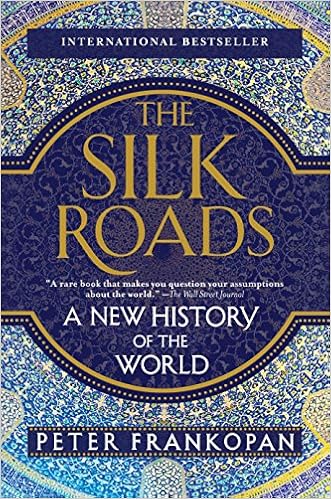
The Silk Roads
The Silk Roads: A New History of the World by Peter Frankopan
Frankopan was fascinated with maps as a child and later as an adolescent.
He writes, Many stories set me on the path to looking at the world's past in a different way. But one stood out in particular. Greek mythology had it that Zeus, father of the gods, released two eagles, one at each end of the earth, and commanded them to fly towards each other. A sacred stone, the omphalos--the navel of the world--was placed where they met, to enable communication with the divine. ... I remember gazing at my map when I first heard this tale, wondering where the eagles would have met. i imagined them taking off from the shores of the western Atlantic and the Pacific coast of China and heading inland. The precise position changed, depending where i placed my finger to start measuring equal distances from east and west. But I always ended up somewhere between the Black Sea and the Himalayas" (xix).
Frankopan explains further that, European history divides Asia into three zones: the Near, Middle, and Far East. Often, the Middle East seems to be the locus of ancient and modern civilization. For Westerners, this idea seems strange when we are taught that the Mediterranean is the heart of civilization. However, looking at the word "Mediterranean" literally "the centre of the world", this fixation on locations in the heart of Asia makes sense.
Frankopan traces the history of the center of world from the ancient, 400 B.C., to the present day. The Silk Road or Roads were created in 119 B.C. when China opened the Gansu corridor after decades of military campaigns: beyond the Pamir Mountains lay a new world. In the Han dynasty, Silk was an important commodity and eventually became international currency.
Although we might refer to the Silk Road, this transcontinental highway was many highways. Silk, grains, jewels, spices, tea, oil, even slaves, and other goods were bought and sold. Ideas, religions, cultures were exchanged and shared. Frankopan's book is a study of the world in transition and in transformation. The Twenty-First Century has seen the emergence of The New Silk Road in the various -stans of the former USSR, in Afganistan, Iraq, Iran, in western China, and elsewhere. The threads of the Silk Roads are being re-knotted, rewoven, and restored.
Frankopan was fascinated with maps as a child and later as an adolescent.
He writes, Many stories set me on the path to looking at the world's past in a different way. But one stood out in particular. Greek mythology had it that Zeus, father of the gods, released two eagles, one at each end of the earth, and commanded them to fly towards each other. A sacred stone, the omphalos--the navel of the world--was placed where they met, to enable communication with the divine. ... I remember gazing at my map when I first heard this tale, wondering where the eagles would have met. i imagined them taking off from the shores of the western Atlantic and the Pacific coast of China and heading inland. The precise position changed, depending where i placed my finger to start measuring equal distances from east and west. But I always ended up somewhere between the Black Sea and the Himalayas" (xix).
Frankopan explains further that, European history divides Asia into three zones: the Near, Middle, and Far East. Often, the Middle East seems to be the locus of ancient and modern civilization. For Westerners, this idea seems strange when we are taught that the Mediterranean is the heart of civilization. However, looking at the word "Mediterranean" literally "the centre of the world", this fixation on locations in the heart of Asia makes sense.
Frankopan traces the history of the center of world from the ancient, 400 B.C., to the present day. The Silk Road or Roads were created in 119 B.C. when China opened the Gansu corridor after decades of military campaigns: beyond the Pamir Mountains lay a new world. In the Han dynasty, Silk was an important commodity and eventually became international currency.
Although we might refer to the Silk Road, this transcontinental highway was many highways. Silk, grains, jewels, spices, tea, oil, even slaves, and other goods were bought and sold. Ideas, religions, cultures were exchanged and shared. Frankopan's book is a study of the world in transition and in transformation. The Twenty-First Century has seen the emergence of The New Silk Road in the various -stans of the former USSR, in Afganistan, Iraq, Iran, in western China, and elsewhere. The threads of the Silk Roads are being re-knotted, rewoven, and restored.
Subscribe to:
Posts (Atom)