Sunday, January 29, 2017

Finding Fontainebleau: An American Boy in France

#29 Finding Fontainebleau: An American Boy in France by Thad Carheart is about la mémoire des lieux or the memory of a place. Carheart and his family, father, mother, and four siblings, lived in France at Fontainebleau for three years during the 1950s while his father worked as a staff officer for NATO. The chapters go back and forth between Carheart's memories, a bit of history, and recent renovations to preserve the chateau. Construction of the chateau was begun in 1137, fifty years before the Louvre and more than five hundred years before Versailles was constructed. Francois Premier, Henri II, Henri IV, Louis XIV, Louis XVI and Marie Antoinette, Napoleon, and Napoleon III have all left their mark on Fontainebleau.

I liked the chapters about France in the 1950s the best, especially the anecdotes about school. For example, Thad was in kindergarten and he and his fellow pupils learned to add and subtract using bottles of wine, (my uncle gives three bottles of wine to my parents who already had five bottles...). Or filling pages in the specially lined notebooks with rows and rows of "i's" or "u's". The French have a very distinct form of handwriting that everyone learns.  I also liked the chapters about fencing; Thad's father was a professional fencer. And the family's camping trip to Rome was memorable as well.

Fontainebleau is on my list of places to go on my next trip to France.


Here's a link to the Chateau's website :Musee Chateau Fontainebleau

Tuesday, January 24, 2017

#28 You Will Not Have My Hate

I accomplished my goal of reading 8 books in January; maybe it will even be ten since I have seven more days.

Book 28 You Will Not Have My Hate, translated from the French (Vous n'aurez pas ma haine) was written by Antoine Leiris. Leiris' wife, Helene Muyal-Leiris, was killed in the terrorist attacks on the Bataclan Theater in Paris on November 13, 2015. You Will Not Have My Hate describes Antoine's desperate attempts to contact his wife, and his grief in the days following her death. On the night of the attacks, Antoine was at home taking care of their seventeen-month old son Melvil. His grief his raw and palpable. I read this with a lump in my throat and tears in my eyes. I cannot imagine having to explain to a small child that their parent is dead. Antoine's writing is powerful and his strength is amazing.

The memoir is structured like a diary and the title comes from this entry.

"On Friday night, you stole the life of an exceptional being, the love of my life, the moth of my son, but you will not have my hate. I don't know who you are and I don't want to know. you are dead souls. If that God for whom you blindly kill made us in his image, each bullet in my wife's body will have been a wound in his heart.

So, no, I will not give you the satisfaction of hating you. That is what you want, but to respond to your hate with anger would be to yield to the same ignorance that made you what you are. You want me to be scared, to see my fellow citizens through suspicious eyes, to sacrifice my freedom for security. you have failed. I will not change" (page 53).

Perhaps we can all apply this thought more in our lives.

I love Paris, and France. Aside from the attacks of September 11th and the terrorist attack in Nice on July 14th 2016, no other terrorist attack has affected me so profoundly. I consider France to be like a second home (if I had enough money that would be a reality). It was very hard for me to reconcile this image of France, with my prior experiences. I felt something intangible had been taken from me.
Paris je t'aime.


Friday, January 20, 2017

My Favorite Pussy

The word pussy has been bandied about lately. I prefer the definition of pussy that refers to an old cat, cunning, clever, and seemingly benign. My favorite pussy is none other than Jane Marple, heroine of Agatha Christie.

I did finish They Do It With Mirrors  starring Miss Marple yesterday (#27), but these descriptions of Miss Marple come from A Murder is Announced. 

Sir Henry Clithering, ex-commissioner of Scotland Yard describes Miss Marple as, "She's just the finest detective God ever made. Natural genius cultivated in a suitable soil."... "In case this turns out to be a high powered mystery, which I don't suppose for a moment it will, remember that an elderly unmarried woman who knits and gardens is streets ahead of any detective sergeant. She can tell you what might have happened and what ought to have happened and even what actually did  happen! And she can tell you why it happened."

Later, the Police receive a letter from an old lady claiming to have some information related to the case that may be useful. The old lady proves to be Miss Marple.

"George, it's my own particular, one and only, four starred Pussy. The super Pussy of all old Pussies. And she has managed somehow to be at Medenhan Wells, instead of peacefully at home in St. Mary Mead, just at the right time to be mixed up in  a murder. Once more a murder is announced--for the benefit and enjoyment of Miss Marple."


Thursday, January 19, 2017

101 Beautiful Small Towns in France

Book #26 : One Hundred and One Beautiful Small Towns in France by Simonetta Greggio.

This 1,000 books project seems to be turning into a "places to go" list. My only complaint with this book was the arrangement of the towns. Greggio's divided them up by region, which was fine, but the regions were presented alphabetically. Given the geographic diversity of France, it was a bit strange to read about towns in Lorraine (north-eastern France near Germany) and then read about towns in Midi-Pyrénées (southern France near Spain). If there had been an introductory page for each region that might have made the literary voyage across France easier, especially for the geographically-challenged like me.

Towns I've visited (from the book):

  • Sarlat: Muse of Montaigne
  • Amboise: also mentioned is Da Vinci's house at Clos Luce and the ancient estate of the Duke de Choiseul with the Pagoda of Chanteloup. 
  • Chartres: Stories in stained glass
  • Reims: Champagne's sparkling heart
  • Versailles: The Sun King's Marble and Mirrors
  • Rocamadour: Vertiginous beauty
  • Giverny: Monet's Garden. This is my favorite place to visit. The house isn't as interesting as the gardens. The house and garden's are open from April to the end of October. It is impossible to take a bad picture in the gardens. I like going at different times during the year because the flowers in bloom change as does the light. The gardens illustrate what Monet sought to capture on canvas: the fleeting nature of light and nature's impressions. 

Towns I'd like to visit (from the book): I seem to prefer towns in the Northern part of France, especially in Alsace, Lorraine, Brittany, and Normandy.

  • Colmar: Alsatian Arts
  • Obernai: Painted Roofs and Pilgrims' Prayers
  • Riquewihr: Storks, Cellars, and Scenery 
  • Beaune: the Best of Burgundy
  • Cancale: the World is Thine Oyster
  • Concarneau: Brittany's Museum
  • Dinan: Breton Beauty and the Beast
  • Pont-Aven: Painters and Bons Vivants
  • Gien: Famous Faience
  • Fontainbleau: France's Most Royal History
  • Provins: Roses and Ramparts
  • Aigues-Mortes: Between Dog and Wolf. Aigues-Mortes was established during the thirteenth century. Saint Louis organized his first crusade, was poor and unarmed. Since Montpellier belonged to the Counts of Toulouse, and Marseilles to the Roman Empire, Aigues-Mortes was his only option for a port. The town is especially suited to the colors at twilight--"between dog and wolf." 
  • Carcassonne: A Colossal Fortress
  • Metz: Architecture, Acoustics, and Art
  • Verdun: Valiant Survivor
  • Honfleur: Impressionism's Source
  • Lille: Tapestries and Traditions
  • Annecy: Crystalline Pools
  • Pérouges: A Walk Through the Middle Ages


Friday, January 13, 2017

#25 The Man Who Snapped His Fingers

I think the book-jacket gives a better summary than I can of this novel.

"Winner of the 2001 French Human Rights Prize, French-Iranian author [Fariba] Hachtroudi's English-language debut explores themes as old as time: the crushing effects of totalitarianism and the infinite power of love. The Man Who Snapped his Fingers is a novel of ideas, exploring power and memory, by an important female writer from a part of the world where female voices are routinely silenced."

The jacket says this is her English debut but the novel was originally published in 2014 as "Le colonel et l'appât 455"

The main characters are Bait 455, an unbreakable prisoner of an ideological republic and one of the colonels closest to the Supreme Commander. They meet years later in unnamed country, although I believe it is Russia. When they meet, they develop, perhaps surprisingly, a relationship based on a shared history of violence and suffering, as well as undying love. 


When I started this novel, it immediately reminded me of a film I had watched in grad-school as part of a Global Women's Cinema course. The film in question was Incendies and is about a former female-prisoner during the Lebanese Civil War. The two female prisoners are notorious for their unbreakable spirit; in the case of Bait 455 she never speaks, and in Nawal, the protagonist of Incendies, she is known as the women who sings "la femme qui chante". Both also have an interesting relationship with their jailers/torturers. 

I have seen the movie of Marjane Satrapi's Persepolis, but I think I will try reading it and perhaps check out Hachtroudi's The Twelth Imam's A Woman?, about her return to Iran after thirty years in exile. 


Wednesday, January 11, 2017

#24 Death in Brittany

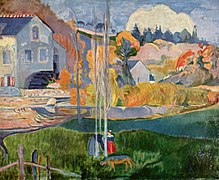
I finished another one last night. Death in Britanny by Jean-Luc Bannalec. Jean-Luc Bannalec is a penname; and Bannalec happens to be a small town in Brittany (see map below). This was originally written in German and is the first in a series about Commissaire Dupin. Dupin is was recently relocated from Paris to Brittany. In this first case, he is called in to investigate the murder of a local hotel owner. There is also question of the theft of unknown painting by Gauguin that had been hanging in the hotel for years.

The mystery was a little slow at first but then it picked up about halfway through. As a Francophile, I enjoyed the descriptions of Brittany: Concarneau and Pont-Aven. Now for sure I will have to go there. And I will check out the next book in the Commissaire Dupin Series.


Gaughin's Le Mouin David de Pont-Aven (1894)


Tuesday, January 10, 2017

Favorite Bedtime books

Here are some of our current favorites to read at bedtime. Most fall into the traditional bedtime story category, but a few do not. My daughter has an ever-expanding library (as do I) so I try to rotate her books every few weeks. This gives her some variety and saves me from reading the same books over and over and over again.

  1. Good Night, Gorilla by Peggy Rathmann: has very few words and a simple premise. (Board book)
  2. The Moon Sees You & Me by Caleb Burroughs: this is a new book, but we read four times in a row the day we got it. "The moon sees you, The moon sees me, Together, apart, Wherever we may be." The rest of the book follows a similar pattern with the sun, wind, rain, snow, sand, waves, and stars. (Board book)
  3. Snuggle Up, Sleepy Ones by Claire Freedman: savannah animals settle down for sleep (Board Book)
  4. The Hug Book: A Little Golden Book. About all the reasons we give hugs
  5. the companion book, Where do kisses come from?. All the reasons we give kisses
  6. Grandfather Twilight by Barbara Berger. This book has beautiful painted illustrations and very few words. Each night, Grandfather Twilight closes his book, puts on his jacket, and goes for a walk through the woods. He is tasked with a very special job each evening--read the book to find out what. 
  7. Stormy Weather by Debi Gliori. This one is one of my favorites. Animal parents assure their little ones that they will protect them in stormy weather. "From north to south and east to west, from cave to berg and twig to nest, a sleepy hush across the world, small creatures in their beds are curled. 
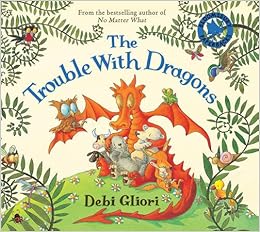
  8. The Trouble with Dragons by Debi Gliori. Not a bedtime book per se, but my daughter loves this. The trouble with dragons is that they don't know how to take care of the earth and are destroying it by making dragons galore, turning up their heaters, and leaving messes. With help from other animals, the dragons learn to reduce and reuse their demands on our natural resources. 
  9. Milk and Cookies by Frank Asch. We are big on dragons in our house. Little Bear thinks a dragon who eats milk and cookies lives in his grandparents' basement. 
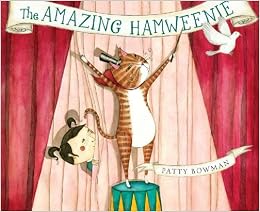
  10. The Amazing Hamweenie by Patty Bowman. I feel this book was actually written with adults in mind. Hamweenie lives in an apartment, in the city. He dreams of grandeur, stardom, of being loved the world over and idolized by children. Nevertheless, he is thwarted at every turn. One of our cats lays on my daughter's bed every night at bedtime, and I think she relates to Hamweenie's frustrations. I just hope she doesn't get too many ideas.