Book 48: The 6:41 to Paris (original French title 06h41) by Jean-Philippe Blondel
Cecile, a stylish 47-year old, has spent the weekend visiting her parents in Troyes, a small town about an hour and a half from Paris. Exhausted by her visit, she takes the 6:41 express train back to Paris on Monday morning. The seat next to her is empty, but before long is occupied by a man from her past. The man is Philippe Leduc, with whom she had a brief, though passionate relationship 30 years ago that left her humiliated.
The narrative is a journey through their respective thoughts and reflections. Each one recognizes the other, but doesn't want to break the silence. They reflect on their past and present lives.
This reminded me of another French novel structured in much the same way. Michel Butor's La Modification, written in 1957. La Modification follows L.D. on a train trip from Paris to Rome. While riding the train, L.D. makes many mental stops and transfers as he reflects on his past romantic relationships.
While reading, I wondered what I would say to a friend or former boyfriend whom I hadn't seen for 30 years if I happened to sit next to him/her on a train or plane. In the 6:41 to Paris, the past is lying is lurking, waiting to ambush Cecile and Philippe.
Friday, April 28, 2017
Wednesday, April 26, 2017
Get Well Soon
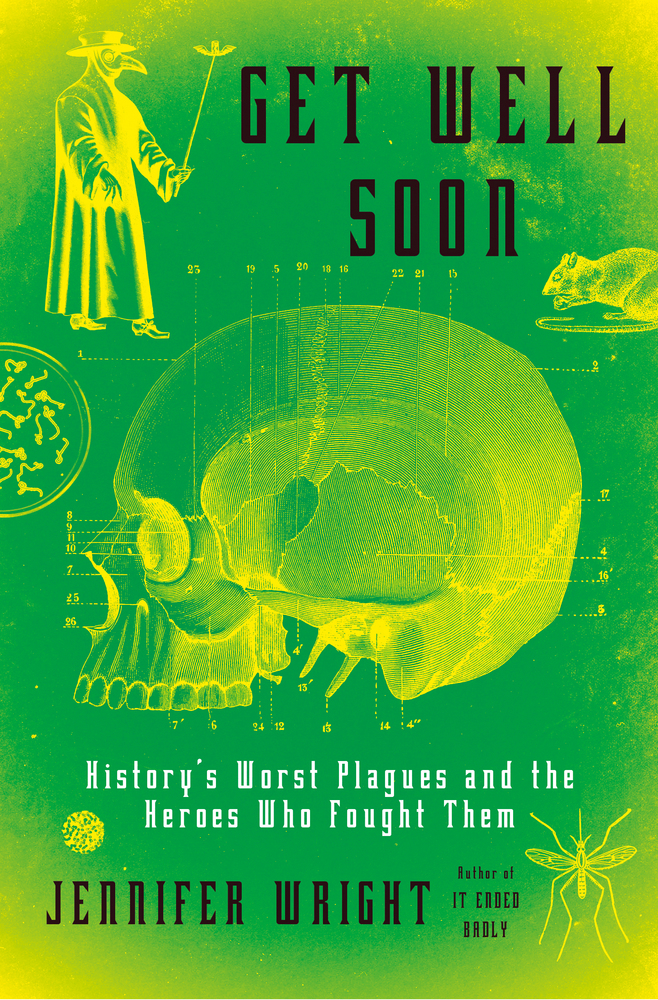
Book 47: Get Well Soon: History's Worst Plagues and the Heroes Who Fought Them by Jennifer Wright
I finished this a few days ago, but moving interrupted my blogging about it. The hypochondriac in me enjoys reading about diseases, and Wright's book about plagues was no exception. Although I have no interest in a career in the sciences or in medicine (I would be a terrible nurse or doctor), I do find these topics interesting.
The plagues include:
The Antonine Plague
Bubonic Plague
Dancing Plague
Smallpox
Syphilis
Tuberculosis
Cholera
Leprosy
Typhoid
Spanish Flu
Encephalitis Lethargica
Lobotomies
Polio
Wright situates each plagues in the historical moment or moments of its outbreak. Known or suspected causes are discussed as well as attempts and successful remedies or cures. Some of the remedies are horrific and others are laughable. For example, to ward off or cure the bubonic plague, it was suggested that people: drink a small amount of good wine, eat crushed emeralds, eat eggs, fruit, and vegetables, not look at sick people, chopping up raw onions and placing them around the house, and drinking your urine/buboes pus. There was also a cure involving exploding frogs and exploding pigeons.
A large part of each chapter is about the attitudes toward a specific plague and how they affect treatment of patients and how we discuss the disease itself. For example, in order to keep morale high during WWI, news of the Spanish Flu outbreak was deliberately censored from the press. This meant that is estimated to have killed 25-100 million people worldwide. Had the outbreak not been kept out of the press for so long, fewer people might have died. In the case of leprosy, there isn't a cure, but treating lepers with compassion and as actual human beings, had a profound effect on their outlook on life. In the case of Polio, a vaccine was ultimately developed because money, resources, and attention were given to combating it.
Although details are sometimes gruesome, Wright's approach is light-hearted and irreverent.
I finished this a few days ago, but moving interrupted my blogging about it. The hypochondriac in me enjoys reading about diseases, and Wright's book about plagues was no exception. Although I have no interest in a career in the sciences or in medicine (I would be a terrible nurse or doctor), I do find these topics interesting.
The plagues include:
The Antonine Plague
Bubonic Plague
Dancing Plague
Smallpox
Syphilis
Tuberculosis
Cholera
Leprosy
Typhoid
Spanish Flu
Encephalitis Lethargica
Lobotomies
Polio
Wright situates each plagues in the historical moment or moments of its outbreak. Known or suspected causes are discussed as well as attempts and successful remedies or cures. Some of the remedies are horrific and others are laughable. For example, to ward off or cure the bubonic plague, it was suggested that people: drink a small amount of good wine, eat crushed emeralds, eat eggs, fruit, and vegetables, not look at sick people, chopping up raw onions and placing them around the house, and drinking your urine/buboes pus. There was also a cure involving exploding frogs and exploding pigeons.
A large part of each chapter is about the attitudes toward a specific plague and how they affect treatment of patients and how we discuss the disease itself. For example, in order to keep morale high during WWI, news of the Spanish Flu outbreak was deliberately censored from the press. This meant that is estimated to have killed 25-100 million people worldwide. Had the outbreak not been kept out of the press for so long, fewer people might have died. In the case of leprosy, there isn't a cure, but treating lepers with compassion and as actual human beings, had a profound effect on their outlook on life. In the case of Polio, a vaccine was ultimately developed because money, resources, and attention were given to combating it.
Although details are sometimes gruesome, Wright's approach is light-hearted and irreverent.
Friday, April 7, 2017
To Capture What We Cannot Keep
To Capture What We Cannot Keep by Beatrice Colin
In 1886, Caitriona Wallace and Emile Nouguier meet in a hot air balloon above Paris. They feel an affinity for one another, but when the balloon lands, their different social positions become apparent. Caitriona (Cait) is a widow who has agreed to chaperone two wealthy, spoiled, and out-of-touch-with-reality Scottish charges, Jamie and Alice Arrol. Emile is one of the engineers building the Eiffel Tower. His mother expects him to take over the family business and find a suitable wife in order to maintain his bourgeois respectability and stability. As the tower is constructed, Cait and Emile must decide how important their love for each other is.
This first passage is from the hot air balloon ascent. "And there, far below, were Baron Haussmann's wide boulevard's that followed the line of the old walls of the city, the green blot of the Bois de Boulgone, the pump of black smoke from the factories in the south, the start spokes radiating from the Place de l'Etoile, and, closer, the Place du Trocadero. And there were lines of carriages as tiny as black beetles, people as minute as ants, the city as small and regular as a set of children's stone building blocks placed on a painted sheet" (17-18).
I loved this description because now the Eiffel Tower is such an iconic part of the Parisian landscape. It's hard to imagine Paris without La Dame de Fer. Though the Eiffel Tower provides one of the best panoramas of Paris, the one thing you cannot see from atop the tower is the tower itself. My favorite vantage point to look out over Paris is from the top of Sacre Coeur or from the top of the Arc de Triomphe.
I also likes this passage about leaving a beloved city, especially Paris. "The morning they had left Paris the sky had been a fathomless blue, the air so clear and clement that everything they were about to leave behind -- the streets, the people, the smell of roasted coffee and chestnuts -- seemed sharper, the colors deeper and more saturated, the verticals and perpendiculars of the city engraved rather than drawn" (108). I find leaving Paris bittersweet, but in order to return, one must leave.
In 1886, Caitriona Wallace and Emile Nouguier meet in a hot air balloon above Paris. They feel an affinity for one another, but when the balloon lands, their different social positions become apparent. Caitriona (Cait) is a widow who has agreed to chaperone two wealthy, spoiled, and out-of-touch-with-reality Scottish charges, Jamie and Alice Arrol. Emile is one of the engineers building the Eiffel Tower. His mother expects him to take over the family business and find a suitable wife in order to maintain his bourgeois respectability and stability. As the tower is constructed, Cait and Emile must decide how important their love for each other is.
This first passage is from the hot air balloon ascent. "And there, far below, were Baron Haussmann's wide boulevard's that followed the line of the old walls of the city, the green blot of the Bois de Boulgone, the pump of black smoke from the factories in the south, the start spokes radiating from the Place de l'Etoile, and, closer, the Place du Trocadero. And there were lines of carriages as tiny as black beetles, people as minute as ants, the city as small and regular as a set of children's stone building blocks placed on a painted sheet" (17-18).
I loved this description because now the Eiffel Tower is such an iconic part of the Parisian landscape. It's hard to imagine Paris without La Dame de Fer. Though the Eiffel Tower provides one of the best panoramas of Paris, the one thing you cannot see from atop the tower is the tower itself. My favorite vantage point to look out over Paris is from the top of Sacre Coeur or from the top of the Arc de Triomphe.
I also likes this passage about leaving a beloved city, especially Paris. "The morning they had left Paris the sky had been a fathomless blue, the air so clear and clement that everything they were about to leave behind -- the streets, the people, the smell of roasted coffee and chestnuts -- seemed sharper, the colors deeper and more saturated, the verticals and perpendiculars of the city engraved rather than drawn" (108). I find leaving Paris bittersweet, but in order to return, one must leave.
Thursday, April 6, 2017
#45 Death Comes to the Village
Death Comes to the Village by Catherine Lloyd is the first book in the Kurland St Mary mysteries.
If I have learned anything from reading Agatha Christie's Miss Marple and watching/reading the Midsommer Murders, it's that life in an English village is anything but tranquil.
In 1816, Major Robert Kurland has returned to his family home in the village of Kurland St Mary following an injury at the Battle of Waterloo (his legs were crushed by a horse). One night he notices a strange figure struggling with a heavy load in the Churchyard. Shortly thereafter, several petty thefts are notices in the houses of the gentry, and two local girls go missing. Major Kurland enlists the help of his childhood friend and the rector's daughter, Lucy Harrington to investigate. As the rector's daughter, Lucy is admitted to houses throughout the village, belonging to people from all social strata.
I enjoyed the banter between Lucy and Major Kurland. I suspected three people of committing the crimes, but none of them turned out to be the culprit. I look forward to reading the second book in the series, Death Comes to London.
If I have learned anything from reading Agatha Christie's Miss Marple and watching/reading the Midsommer Murders, it's that life in an English village is anything but tranquil.
In 1816, Major Robert Kurland has returned to his family home in the village of Kurland St Mary following an injury at the Battle of Waterloo (his legs were crushed by a horse). One night he notices a strange figure struggling with a heavy load in the Churchyard. Shortly thereafter, several petty thefts are notices in the houses of the gentry, and two local girls go missing. Major Kurland enlists the help of his childhood friend and the rector's daughter, Lucy Harrington to investigate. As the rector's daughter, Lucy is admitted to houses throughout the village, belonging to people from all social strata.
I enjoyed the banter between Lucy and Major Kurland. I suspected three people of committing the crimes, but none of them turned out to be the culprit. I look forward to reading the second book in the series, Death Comes to London.
Monday, April 3, 2017
A Killer Read
I've lost count. My latest read was Erika Chase's A Killer Read, the first in the Ashton Corners Book Club Mysteries.
The Ashton Corners Mystery Readers and Cheese Straws Society meets in Molly Mathews' house. Their first meeting is interrupted by a stranger who is later found shot to death in his car after the meeting. An antique gun that belonged to Molly's deceased husband was used as the murder weapon. Following the murder, Lizzie (the protagonist) begins to receive manuscript pages from an anonymous source that could be clues to the murder. Lizzie also receives cryptic phone calls in the middle of the night asking about the story her father was investigating prior to his death (her father was a newspaper reporter).
Suspicion falls on members of the reading club:
The Ashton Corners Mystery Readers and Cheese Straws Society meets in Molly Mathews' house. Their first meeting is interrupted by a stranger who is later found shot to death in his car after the meeting. An antique gun that belonged to Molly's deceased husband was used as the murder weapon. Following the murder, Lizzie (the protagonist) begins to receive manuscript pages from an anonymous source that could be clues to the murder. Lizzie also receives cryptic phone calls in the middle of the night asking about the story her father was investigating prior to his death (her father was a newspaper reporter).
Suspicion falls on members of the reading club:
- Lizzie Turner: literacy and reading specialist in Ashton Corners. Lizzie also has two Siamese cats, Edam and Brie. The cats aren't involved in solving the crime, much as I hoped because I love a good cat mystery, but they are nice additions to the story.
- Molly Mathews: prominent citizen of Ashton Corners whose house is the meeting place for the mystery readers club and other literacy groups.
- Bob Miller: retired police chief.
- Andie: a high school student and one of students in Lizzie's literacy group.
- Stephanie: a nineteen-year old pregnant woman who is new to Ashton Corners and reticent to reveal anything about her background.
- Sally-Jo: teacher and reading specialist
- Jacob Smith: a new lawyer in town and friend of Bob Miller's
Friday, March 31, 2017
Norse Mythology
To finish March and my slew of folklore and legends, I read Neil Gaiman's Norse Mythology (published 2017). I was familiar with the major players in Norse mythology, Odin, Thor, Freya, and Loki, but not with the actual stories. Gaiman retells these stories and creates a story arc that begins with the creation of the nine worlds and ends with Ragnarok, the death of the gods.
I liked "Yggdrasil and the Nine Worlds", "The Treasures of the Gods", "Freya's Unusual Wedding", "The Last Days of Loki" and "Ragnarok: The Final Destiny of the Gods". There is also a glossary of terms at the end which I found handy. I think Loki, the trickster, is one of the most interesting of the characters, although I don't particularly like him. I do like Freya and her chariot pulled by cats.
Wednesday, March 29, 2017
Eight Months on Ghazzah Street
Book 43 (I think) is Eight Months on Ghazzah Street, described by critics as a Middle Eastern Turn of the Screw. I have vague memories of Turn of the Screw from high school English. Two children and their possessed governess in England.
Anyway, in Eight Months on Ghazzah Street, Frances Shore and her engineer husband move to Jeddah, Saudi Arabia. Instead of living in an apartment complex for British ex-pats, the Shores live in a sublet on Ghazzah Street with Saudi nationals and other Muslims.
Though she ventures out into the city, most of Frances' days are spent alone in their apartment or visiting the two housewives who also live in the building. She keeps a travel diary, goes on the roof to get some sun, and listens to the goings-on in the other apartments, especially the supposedly empty apartment above theirs. Frances decides to investigate and her suspicions increase throughout their eight months on Ghazzah Street. Some parts of the book were slow, but my interest grew alongside Frances' suspicions.
I liked this description of the supermarket: "The supermarkets are all well stocked, but there is always some elusive item; this breeds the desire to go to more supermarkets. shopping is the highest good in Saudi life. Every need and whim under one roof--Lebanese pastries, a Mont Blanc pen, a diamond snake with emerald eyes; a pound of pistachio nuts, two tickets to Bermuda, a nylon prayer rug with built-in compass. Perhaps some blueberry cheesecake ice cream, and Louis Quinze fauteuil; a new Toyota, and a portrait of the King. The car parks consume acres, the facades glitter like knives" (Mantel 96).
Eight Months on Ghazzah Street is part travel journal, albeit not a very factual one, and part mystery.
Anyway, in Eight Months on Ghazzah Street, Frances Shore and her engineer husband move to Jeddah, Saudi Arabia. Instead of living in an apartment complex for British ex-pats, the Shores live in a sublet on Ghazzah Street with Saudi nationals and other Muslims.
Though she ventures out into the city, most of Frances' days are spent alone in their apartment or visiting the two housewives who also live in the building. She keeps a travel diary, goes on the roof to get some sun, and listens to the goings-on in the other apartments, especially the supposedly empty apartment above theirs. Frances decides to investigate and her suspicions increase throughout their eight months on Ghazzah Street. Some parts of the book were slow, but my interest grew alongside Frances' suspicions.
I liked this description of the supermarket: "The supermarkets are all well stocked, but there is always some elusive item; this breeds the desire to go to more supermarkets. shopping is the highest good in Saudi life. Every need and whim under one roof--Lebanese pastries, a Mont Blanc pen, a diamond snake with emerald eyes; a pound of pistachio nuts, two tickets to Bermuda, a nylon prayer rug with built-in compass. Perhaps some blueberry cheesecake ice cream, and Louis Quinze fauteuil; a new Toyota, and a portrait of the King. The car parks consume acres, the facades glitter like knives" (Mantel 96).
Eight Months on Ghazzah Street is part travel journal, albeit not a very factual one, and part mystery.
Subscribe to:
Posts (Atom)