Saturday, January 12, 2019

Monet's Table: The Cooking Journals of Claude Monet

Monet's Table: The Cooking Journals of Claude Monet text by Claire Joyes and Photographs by Jean-Bernard Naudin

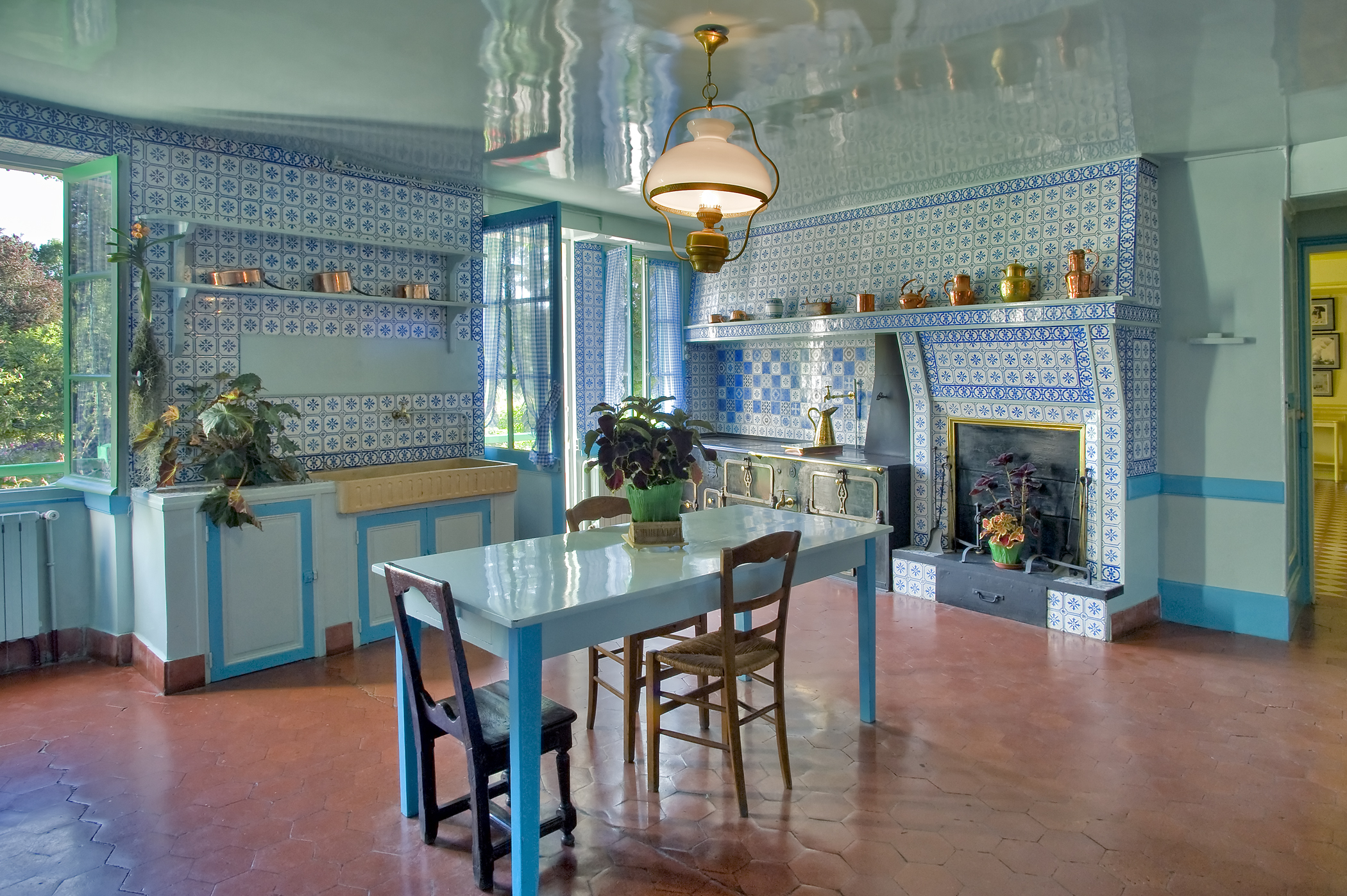
My favorite artist is Claude Monet and my favorite place to visit in France is Monet's home, studio, and gardens at Giverny. I far prefer to stroll about the gardens (despite the fact they are overrun with tourists) than to walk through Monet's little pink house. But, I do remember looking at Monet's yellow kitchen on previous visits to Giverny and Jean-Bernard Naudin's photographs bring it all back.

Monet was a foodie and had a hearty appetite. When guests came to Giverny, which was frequently, they were treated to lavish meals. Family meals were often special as well, even on a daily basis. His dining preferences reflect the over-indulgence typical of the French middle-class in the late Nineteenth and early Twentieth centuries. Monet's taste in food developed alongside his art at Giverny where he settled in 1883. Monet and his second wife Alice created their own style. "Their sole culinary ambition was to serve beautifully prepared dishes using whatever the kitchen-garden or the farmyard could supply. This was their food, homemade but often making use of recipes invented by the great restaurants they patronized, or even dished created by their friends, who included writers, art collectors, painters and actors" (19). For example, Cézanne provided the recipe for Boullabaisse de mourue (Salt cod soup), the Tatin Sisters themselves shared their recipe for their namesake upside-down cake, Tarte Tatin, with Monet and his family, and Mallarmé passed on his Recette de girolles (Recipe for chanterelles). Chef Joel Robuchon has tested and adapted the recipes found in Monet's cooking journals and you can make them yourself.

The kitchen-garden was a beautiful and well-tended as the flower garden. However, aesthetics that were favored among the flowers were banned among the vegetables. In the kitchen-garden, "there was a strict geometrical plan and paths were laid out in straight lines, to allow the work to be carried out logically, rapidly, and with minimum effort" (44).


Monet's blue kitchen:
The yellow dining room (I want dishes like these)


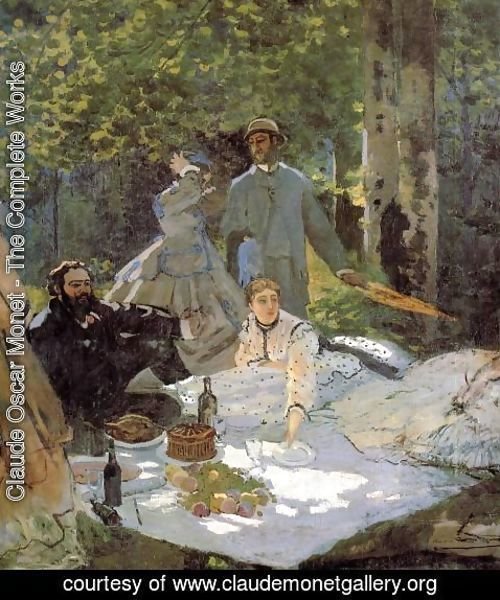
Monet's Luncheon on the Grass (1865-66)

Sunday, January 6, 2019

When Paris Sizzled

My latest read, and a great one, was When Paris Sizzled: The 1920s Paris of Hemingway, Chanel, Cocteau, Cole Porter, Josephine Baker, and Their Friends by Mary McAuliffe

McAuliffe's books primarily explores the Parisian cultural, artistic and social scenes, with forays into politics and economics, during the decade following World War I. The Roaring Twenties or les Années folles, spanned the precarious peace in November 1918 to the crash on Wall Street in late October of 1929. The Crazy Years ushered in changes in art, literature, music, fashion, architecture, transportation and behavior. France suffered terrible loses in the war, one and a half million dead and almost three million wounded, the first order of business was to move on from the atrocities of war. Frenchmen and expats alike drowned their sorrows in alcohol and danced their cares away, in the bars and clubs of Montmartre, but especially in Montparnasse where Kiki reigned as Queen. Pleasure, excess, and hedonism contrasted with others' daily struggles.

The cast of characters in McAuliffe's chronicle is large: Monet, Le Corbusier, Chanel, Hemingway, Cole Porter, Josephine Baker, Sylvia Beach, Gertrude Stein, Citroen, Renault, Picasso, Andre Breton, Serge Diaghilev, Maurice Ravel, and many more. Their boundless creativity was matched only by a desire to upset tradition and order, tensions that would escalate over the course of the decade.

Eventually the bubble burst. The crash of 1929 did not have immediate effects in France. But, eventually the American and British tourists ran out of money to spend and settled in less expensive areas or returned home.  "Wherever they landed, they brought with them memories of a decade that, in hindsight, appeared gloriously carefeee and joyous, whether viewed as an amusing alcohol-fueled escapade or as a kind of Camelot. In memory, les Années folles sizzled and glowed, to the accompaniment of an isistent jazz beat" (271). However, much of the memory of the Crazy Years was exaggerated or distorted--a darkness always lurked next to the sparkle and sequins.


Saturday, January 5, 2019

Happy New Year

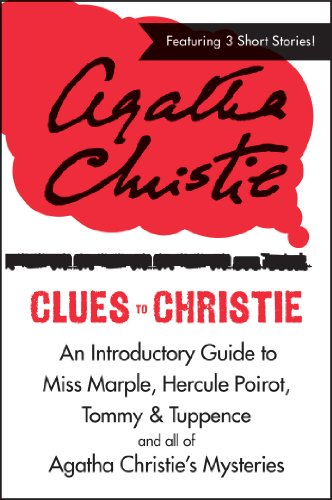
The New Year means new books, new authors, and new reading goals, but also rediscovering and enjoying old favorites. Today I picked up a short little book called Clues to Christie: An Introductory Guide to Miss Marple, Hercule Poirot, Tommy and Tuppence and all of Agatha Christie's Mysteries. At only 127 pages, that is a lot of ground to cover and indeed it really is an introduction. I didn't learn anything new about Christie, except that she is quite the playwright as well as novelist. So often fans read her books according to the detective that is featured. Here, her novels were presented in this "traditional" manner, but also in different categories. Death by Strangulation: examples include The Clocks, Nemesis, Sleeping Murder; Death by Poison: The Clocks, Five Little Pigs, After the Funeral; Death by Nursery Rhyme: And Then There Were None, By the Pricking of my Thumbs, Five Little Pigs, Hickory Dickory Dock; or Death by the Seven Deadly Sins: The A.B.C. Murders (Pride), Five Little Pigs (anger), At Bertram's Hotel (Gluttony), Evil Under the Sun (lust), A Murder is Announced (envy), A Pocketful of Rye (sloth), and Death on the Nile (greed).


Saturday, December 29, 2018

The Agatha Christie Book Club

My latest read is C.A. Larmer's The Agatha Christie Book Club

Bored with her current book club, Alicia Finlay decides to start her own book club dedicated to the works of Agatha Christie. She places an advertisement in the paper asking interested parties to write and seek membership in the club. From the letter she receives, Alicia selects six members: her sister Lynette; Dr. Anders, an expert on poisons; Claire a retro fashionista; Missy the ditzy yet observant librarian whose insight into human nature rivals that of Miss Marple; Perry the paleontologist, and socialite Barbara Parlour.
The first book they discuss is Evil Under the Sun. At their next meeting to discuss The Mysterious Affair at Styles, Barbara doesn't show up. Concerned for her well-being, the ACBC looks into her disappearance. They become more concerned when her husband is murdered several days later. Alicia and her friends delve into Agatha Christie's own life and her novels to solve the case of the missing book club member.


This is the first book in a three-book series: Murder on the Orient (SS) and Evil Under the Stars are the other two books.

Friday, December 28, 2018

Mariage Freres: The French Art of Tea


Mariage Frères : The French Art of Tea is part history of the Mariage Frères Tea Company and part catalogue of their teas.

Tea first became popular in France during the reign of Louis XIV. In the 1660s, Nicolas Mariage embarked on several voyages to Persia, the East Indies and the Moghul Empire as part of an envoy sent by Louis XIV and the French East India Company. Nicolas’ brother travelled to Madagascar with the same company. In the 18th century, Jean-Francois Mariage was still trading in tea. In 1854, Henri and Edouard, grandsons of Jean-Francois, founded the Mariage Frères Tea Company on June 1st. The name has been and still is synonymous with the highest quality teas.

The descriptions of various teas from around the world and the teas sold by Mariage Frères is a catalogue of superlatives, some of them exaggeratingly hilarious. Teas are described as “precious”, “charismatic”, “most civilized”, “paradise”, or even “evidence of a peerless marriage.”

I do love the fact that there are teas for every taste and occasion. These are teas I want to try:

T221 Lung Ching or Dragon’s Well “Produced on the summits of the Tieh Mu Mountain chain near the western lake of Hangzhow in Zheigang. The garden boasts white sandy soil and a perfect climate for growing tea. Lunch Ching’s liquor resembles liquid jade, and has a delicious aroma that fills the palate with a delicate fragrance. An ideal tea while reading” (41).

T227 Long Zhong Cui Lu “A tea of fine pedigree, with an orange-yellow liquor and highly pronounced aroma. A subtle tea, appropriate when curling up with a book” (42).

 A white Darjeeling tea with a description too great to miss
T144 Neige de jade “‘Jade Snow’ was conceived like a precious work of art on the Arya estate in Darjeeling. It is a unique white tea from the land of the finest black teas—the leaves, plucked as dawn, are carefully spread in the sweet morning air, then each leaf is wrapped in silk cloth and rolled by hand, and finally placed in gentle sunlight. The crystalline liquor yields a refined taste of young growth with overtones of white flowers. The subtle fragrances of this grand tea last long in the mouth, whispering of rare pleasures” (63).

The name of this next tea immediately called to mind Agatha Christie and Poirot
T955 Thé sur le Nil « A whiff of adventure: this blend will take you to the ends of the world, where the thoughts of enchanted voyagers dwell. Citrus fruit from forgotten lands and refined spices wonderfully scent this fine green tea. A flight of fancy—a timeless tea” (102).

And lastly,
T962 Thé des Impressionnistes “In the wild, rocky, maritime region of Provence in southern France, nature’s shimmering colours create rare and intense harmonies that delighted Impressionist artists. This green tea, scented with mild spices and white flowers, is also dotted with mauve flowers as a visual echo of the sizzling and powerful; fragrance that fills the mouth. A colorful tea” (103).


Wednesday, December 26, 2018

The Poetry of Us

The Poetry of Us is another great book published by National Geographic. I found it in the children's section at the library. I think it would be ideal for ages 6 and up, but I enjoyed reading it. The Poetry of Us is a collection of 200+ poems that celebrate the history, regions, passions, and people of the United States. Some of the poems are well known such as America the Beautiful or by famous authors such as Maya Angelou, Walt Whitman, and Langston Hughes. Other authors are probably famous in their own right.

The collection is divided into regions and I found that the poems for each region had a particular flavor and thematic elements running through them. It was fun to read poems about places I have lived or have visited such as Chicago or Iowa.


A Very Vintage Christmas

A Very Vintage Christmas by Bob Richter

Bob Richter is a flea market guru and star of the PBS show Market Warriors. In A Very Vintage Christmas, Richter shares his love of Christmas and how to find, collect, and display vintage Christmas items. He also provides an overview of how different decorations changed over time: trees, lights, yard displays, ephemera, and ornaments.

I remember decorating my bedroom for Christmas growing up. I still have some of the wooden ornaments from my childhood tree. My three favorites are a wooden lion-rocking horse, a wooden sleigh, and a walrus with a wreath around it's neck. This year my mom gave me a polar bear ornament that I have long-admired from the family tree.